; ; ; ; ; Civil Engineering Blog: dams

keywords

Most popular categories
free niche civil engineering software jobs degree course manual powerpoint calculation sheet books finite element concrete steel environment ACI AASHTO PCI Transportation Railsway Logistics nuclear FRP strengthening repair material price Earthquake Bridge Train Home Building Factory GPS GIS Survey Structural Engineering
------------------------------------------------------------------
Showing posts with label dams. Show all posts

Thursday, October 14, 2010

Hoover dam bridge finally completed: Hot News

A soaring bridge that will let drivers bypass the Hoover Dam - and steer clear of its security checkpoints and tourists - will open after nearly eight years and £151 million worth of work.
The 1,900ft engineering wonder perched 890ft above the Colorado River is expected to slash travel time along the main route between Las Vegas, Nevada, and Phoenix, Arizona, as motorists will no longer have to make their way across the dam's winding two-lane road at a snail's pace.

Friday, October 1, 2010

Reinforced concrete Design philosophy and concepts

Reinforced concrete Design philosophy and concepts

The design of a structure may be regarded as the process of selecting proper materials and proportioned elements of the structure, according to the art, engineering science and technology. In order to fulfill its purpose, the structure must meet its conditions of safety, serviceability, economy and functionality.
Serviceability: No excessive deflection, no excessive deformation and no cracking or vibrations No excessive reinforcement. Must be able to perform the function, it is built for.

Strength design method

It is based on the ultimate strength of the structural members assuming a failure condition, whether due to the crushing of concrete or due to the yield of reinforced steel bars. Although there is additional strength in the bar after yielding (due to Strain Hardening), this additional strength in the bar is not considered in the analysis or design of the reinforced concrete members. In the strength design method, actual loads or working loads are multiplied by load factor to obtain the ultimate design loads. The load factor represents a high percentage of factor for safety required in the design. The ACI code emphasizes this method of design.

Working stress design

This design concept is based on elastic theory, assuming a straight line stress distribution along the depth of the concrete. The actual loads or working loads acting on the structure are estimated and members are proportioned on the basis of certain allowable stresses in concrete and steel. The allowable stresses are fractions of the crushing strength of concrete (fc') and the yield strength (fy). Because of the differences in realism and reliability over the past several decades, the strength design method has displaced the older stress design method.

Limit state design

It is a further step in the strength design method. It indicates the state of the member in which it ceases to meet the service requirements, such as, loosing its ability to withstand external loads or local damage. According to limit state design, reinforced concrete members have to be analyzed with regard to three limit states:
  1. Load carrying capacity (involves safety, stability and durability)
  2. Deformation (deflection, vibrations, and impact)
  3. The formation of cracks
The aim of this analysis is to ensure that no limiting sate will appear in the structural member during its service life.

what is Reinforced Concrete ?

Concrete is a stone like substance obtained by permitting a carefully proportioned mixture of cement, sand and gravel or other aggregate and water to harden in forms of the shape and of dimensions of the desired structure.

Reinforced cement concrete:

Since concrete is a brittle material and is strong in compression. It is weak in tension, so steel is used inside concrete for strengthening and reinforcing the tensile strength of concrete. The steel must have appropriate deformations to provide strong bonds and interlocking of both materials. When completely surrounded by the hardened concrete mass it forms an integral part of the two materials, known as "Reinforced Concrete".

Advantages and disadvantages of reinforced concrete

Reinforced Concrete is a structural material, is widely used in many types of structures. It is competitive with steel if economically designed and executed.
   

Advantages of reinforced concrete

  • It has relatively high compressive strength
  • It has better resistance to fire than steel
  • It has long service life with low maintenance cost
  • In some types of structures, such as dams, piers and footings, it is most economical structural material.
  • It can be cast to take the shape required , making it widely used in pre-cast structural components.
  • It yields rigid members with minimum apparent deflection.
  • Yield strength of steel is about 15 times the compressive strength of structural concrete and well over 100 times its tensile strength
  • By using steel, cross sectional dimesions of structural members can b ereduced e.g in lower floor columns.

Disadvantages of reinforced concrete

  • It needs mixing, casting and curing, all of which affect the final strength of concrete.
  • The cost of the forms used to cast concrete is relatively high.
  • It has low compressive strength as compared to steel (the ratio is about 1:10 depending on material) which leads to large sections in columns/beams of multistory buildings Cracks develop in concrete due to shrinkage and the application of live loads

Thursday, September 30, 2010

Hoover Dam

Hoover Dam,
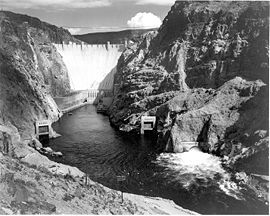
once known as Boulder Dam, is a concrete arch-gravity dam in the Black Canyon of the Colorado River, on the border between the US states of Arizona and Nevada. It was constructed between 1931 and 1936, and was dedicated on September 30, 1935, by President Franklin Roosevelt. Its construction was the result of a massive effort involving thousands of workers, and cost over a hundred lives.

Since about 1900, the Black Canyon and nearby Boulder Canyon had been investigated for their potential to support a dam that would control floods, provide irrigation water and produce hydroelectric power. In 1928, Congress authorized the project. The winning bid to build the dam was submitted by a consortium called Six Companies, Inc., which began construction on the dam in early 1931. Such a large concrete structure had never been built before, and some of the techniques were unproven. The torrid summer weather and the lack of facilities near the site also presented difficulties. Nevertheless, Six Companies turned over the dam to the Federal government on March 1, 1936, more than two years ahead of schedule.

Hoover Dam impounds Lake Mead, and is located near Boulder City, Nevada, a municipality originally created for workers on the construction project, about 30 miles (48 km) south of Las Vegas, Nevada. The dam's generators provide power for public and private utilities in Nevada, Arizona and California. Hoover Dam is a major tourist attraction, and U.S. 93, a heavily travelled road, runs along its crest. In late 2010, through traffic will be rerouted onto a bypass presently under construction, and the dam roadway will be restricted to use by visitors.

For his history of a famous piece of infrastructure, Hiltzik selects one without compare. Decked out in art deco, the Hoover Dam is a beautiful immensity that awes throngs of visitors, and it boasts a construction epic reflecting Depression-era America: the first to impound the Colorado River, the dam is both product and symbol of the politics of water rights in the American West. It is the 1920s iteration of the latter on which Hiltzik, a business writer for the Los Angeles Times, embarks in his fascinating account of the genesis of the Boulder Canyon Project, as the enabling congressional act called the yet-unnamed dam. Starting the story at the torrid desert job site, Hiltzik recounts the rigorous organization of the project by the contract-winning consortium and its engineering chief, Frank Crowe. If Crowe's solutions to technical problems were audaciously titanic, the labor practices of his bosses were pitiless. Strikes were crushed; slack safety resulted in numerous deaths; and a whites-only hiring policy prevailed. Astutely conveying the characters of its creators, Hiltzik marvelously captures the times of the Hoover Dam. Read More on this Colossus: Hoover Dam and the Making of the American Century